< back to Counseling
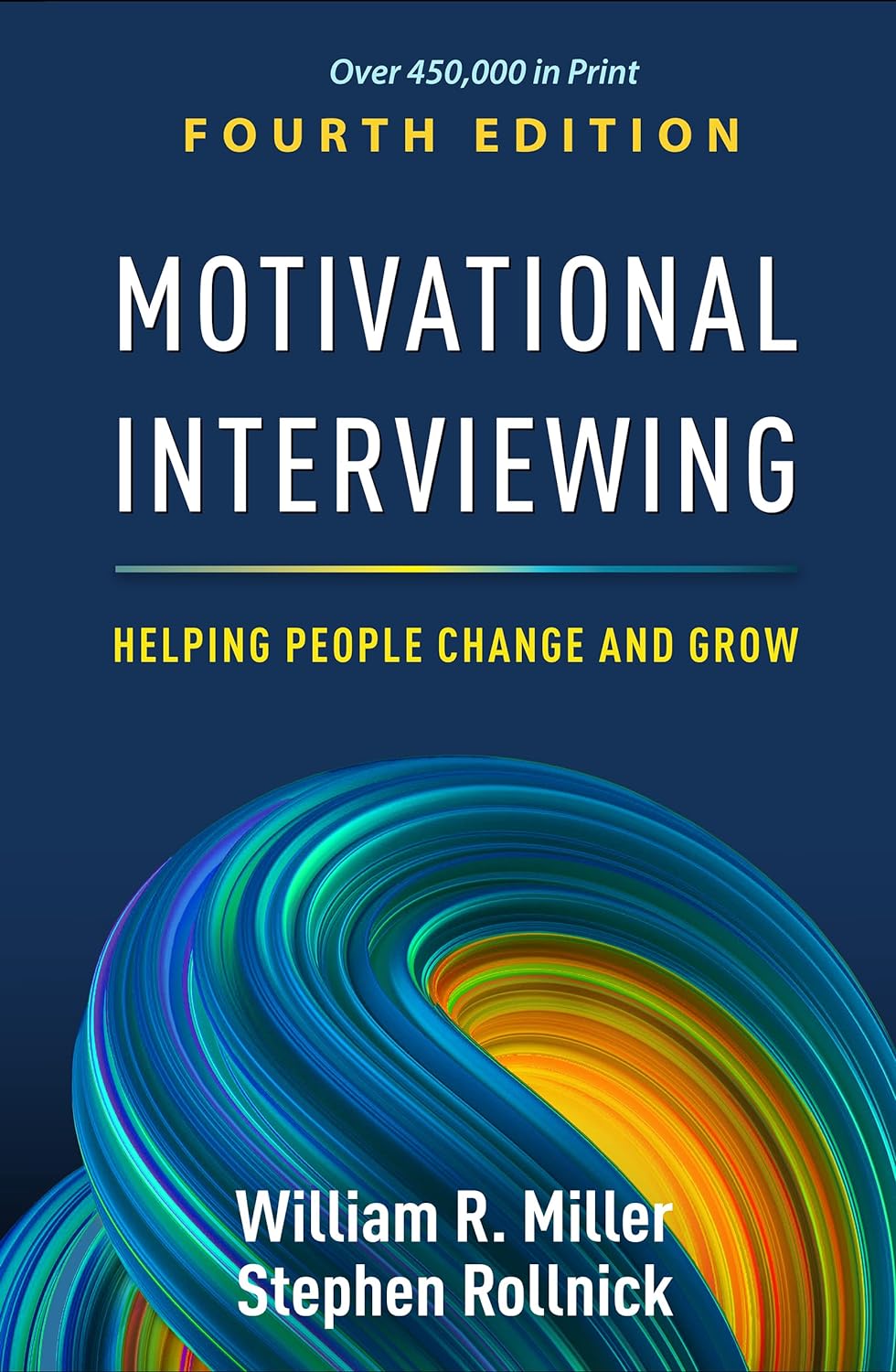
Motivational Interviewing
by William R Miller, Stephen Rollnick
Published: 2023, 4th edition
Goodreads: goodreads.com/book/show/123007184
Author website: williamrmiller.net
The book's subtitle defines the goal of MI: "Helping people change and grow."
Conveniently, the first page of the book describes how MI aims to achieve this goal.
"For a definition, MI is a particular way of talking with people about change and growth to strengthen their own motivation and commitment."
The mortal enemy of MI is: Ambivalence. Here's why.
"When considering change, a person commonly experiences ambivalence—simultaneously wanting and not wanting it. Ambivalence about change is quite normal and is not resistance or pathology."
Putting it all together...MI is a way of talking with people that helps them overcome ambivalence so they can change and grow.
There is a counseling trick here. Simply ignoring a client's ambivalence or directly confronting a client is usually counter-productive. MI provides counselors with an approach that tackles ambivalence without making the client defensive.
A counselor uses the MI approach to nudge his client toward change talk. Change talk is "any speech that favors movement toward a particular change goal." The same counselor hopes to move the client away from sustain talk, which is "any speech that favors status quo rather than movement toward change."
MI is an approach rather than a full-blown therapy modality or theory of change. Since MI is a way of talking, counselors usually get better at it with experience. MI is a humanistic approach where empathy and rapport with the client is essential.
Pros — The author is the creator of MI; the MI approach is straightforward; MI is popular in helping clients overcome addiction
Cons — None. I like MI, the technique and the book. (smile)
Key terms — ambivalence, change talk, sustain talk, OARS = {Open-ended questions, Affirming, Reflecting, Summarizing}